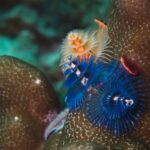

Have you ever wanted to touch and ruffle a coral as much as this one? Well, sadly you can’t: a bubble coral’s inflated polyps are fragile and easily damaged. We’ll all have to resist the temptation and just enjoy its unique, bubbly shape from afar.
Bubble coral isn’t the easiest of the large polyp stony types to care for, but its unique looks make it more than worth a try. Find everything you need to know to get yours to thrive and grow in your reef below.
| Name (Common, Scientific) | Bubble Coral, Grape Coral, Pearl Coral, Bladder Coral, Plerogyra sinuosa |
| Temperature | 75–83°F |
| Salinity | 1.024–1.026 |
| pH | 8.0–8.4 |
| Difficulty level | Intermediate to advanced |
| dKH | 8–10 |
| Calcium | 400–450 ppm |
| Magnesium | 1250–1350 |
| Light level | Low to moderate (75–150 PAR) |
Bubble Coral Appearance & Natural Habitat
Appearance
This coral really does look like nature’s original bubble wrap! The bubbles are the size of small grapes and can vary from smooth and oval to all sorts of geometric, rounded shapes. They deflate somewhat at night and inflate to full roundness during the day.
Most bubble corals are beige to light brown in color, but they can also be white or sport a greenish or pink tinge. When fully inflated, the bubbles show loopy, arched lines that look a little like fingerprints.
The most common bubble coral in the reef hobby is Plerogyra sinuosa, but we’ve also come across the similar P. flexuosa and the branching P. simplex. Keep in mind they’re not always labeled correctly in aquarium stores. Because the bubble shape can vary so much, ID’ing small frags can be difficult.
Did you know? If you like the Plerogyra bubble corals, be sure to also check out the closely related pearl bubble coral (Physogyra lichtensteini)

Natural Habitat
Bubble coral has a wide natural range in the Indo-Pacific, inhabiting tropical reefs all the way from the Red Sea to the Central Pacific islands. It can grow to huge sizes in the wild — peep the one we spotted in the Red Sea above. The colony was growing on a round boulder 3–4ft across, covering it entirely to give it a brain-like look.
We also spotted wild bubble corals while diving in Thailand, although those were a lot smaller and had the more typical, rounded polyps. If you happen to come across one on a dive, be sure to take a closer look and see if you can spot symbionts like ghost gobies, bubble coral shrimp, or orangutan crabs.
Being zooxanthellate, these corals are exclusively found in the shallows, where light can penetrate. They mostly grow on vertical walls and don’t mind slightly turbid water.


Bubble Coral Care
The trickiest time for a bubble coral is when you transport it home and the first few weeks it spends in your reef. Their fragile bubbles are easily damaged in transit, which can allow infections to take hold. In unlucky cases, this causes the entire colony to rot.
To prevent damage to the coral, always lightly shake it or fan the polyps so they retract before the colony is lifted out of the water. Make sure it’s very stable in its transport bag or container to prevent the sharp skeleton from popping its own bubbles.
Light & Flow
This coral’s pillowy bubbles are very fragile, making them intolerant to high flow levels. You’re looking for very slight bubble sway; any more and the polyps won’t open fully or can even tear.
Light is less of an issue. Bubble corals are pretty flexible in terms of brightness, and we’ve grown them under surprisingly low light. A brighter spot isn’t a problem either, but unless you can confirm otherwise, you should assume yours is used to shaded conditions.
Always acclimate your coral to higher light over the course of a few weeks or months, keeping an eye on the bubbles. Research shows they shrink if the light is too bright; if you think you’ve overdone it, move the colony back to a more shaded spot and try again in a week or two.
Compatibility
One thing’s for sure: bubble corals will definitely never feature in our list of peaceful coral species. They may look soft and cuddly, but they wage relentless nightly war on their neighbors using their stinging sweeper tentacles.
Keep your bubble coral well away from your other prized colonies, as they’ll kill almost anything they come across. Their sweepers can grow to 5″ in length, so the best place for them is on an isolated island placed downstream and some distance away from the rest of your reef.
Maintenance
If your bubble coral has managed to survive the first month after bringing it home, it should be in the clear and not too difficult to care for. Most important to keeping it alive, growing, and with polyps fully extended are stable alkalinity and calcium levels.
You’ll have to dose regularly to keep the mineral concentration just right. Don’t skip regular maintenance, because bubble coral is also sensitive to high phosphate levels. It’s not as challenging as SPS, but we do find it to be a bit finicky for an LPS.
Although they have zooxanthellae, bubble corals grow best when they receive a meal every 1–2 weeks. They’re not picky at all, so just spot feed yours any meaty coral food when you catch it with its feeding tentacles extended.

Fragging
Their fragility and susceptibility to brown jelly disease makes bubble corals difficult to frag. Cutting straight through one with a rotary tool like you would for other corals is likely to end up killing it.
If you do want to take the plunge and frag your bubble coral, it’ll be a matter of finding the spaces between the polyps and using a Dremel or drill bits to carefully cut, wedge, and wiggle your way through until it cracks apart. The skeleton is very porous, so take your time.
If you don’t have much experience fragging corals, this definitely isn’t the best species to start with!
Need Help?
A beautiful reef tank full of bubbles gently swaying in the flow is a real sight to see, but corals like the bubble coral do need specialized care and careful monitoring. And again, we know it’s tempting, but no touchy!
If you don’t have the time to set up and maintain your home or office reef, the FantaSEA team can help. We’ll design, build, and maintain your saltwater tank for you so all you have to do is enjoy its beautiful colors — just and we’ll make your dream aquarium reality.
Sources & Further Reading
Levy, O., Dubinsky, Z., & Achituv, Y. (2003). Photobehavior of stony corals: responses to light spectra and intensity. Journal of Experimental Biology, 206(22), 4041-4049.