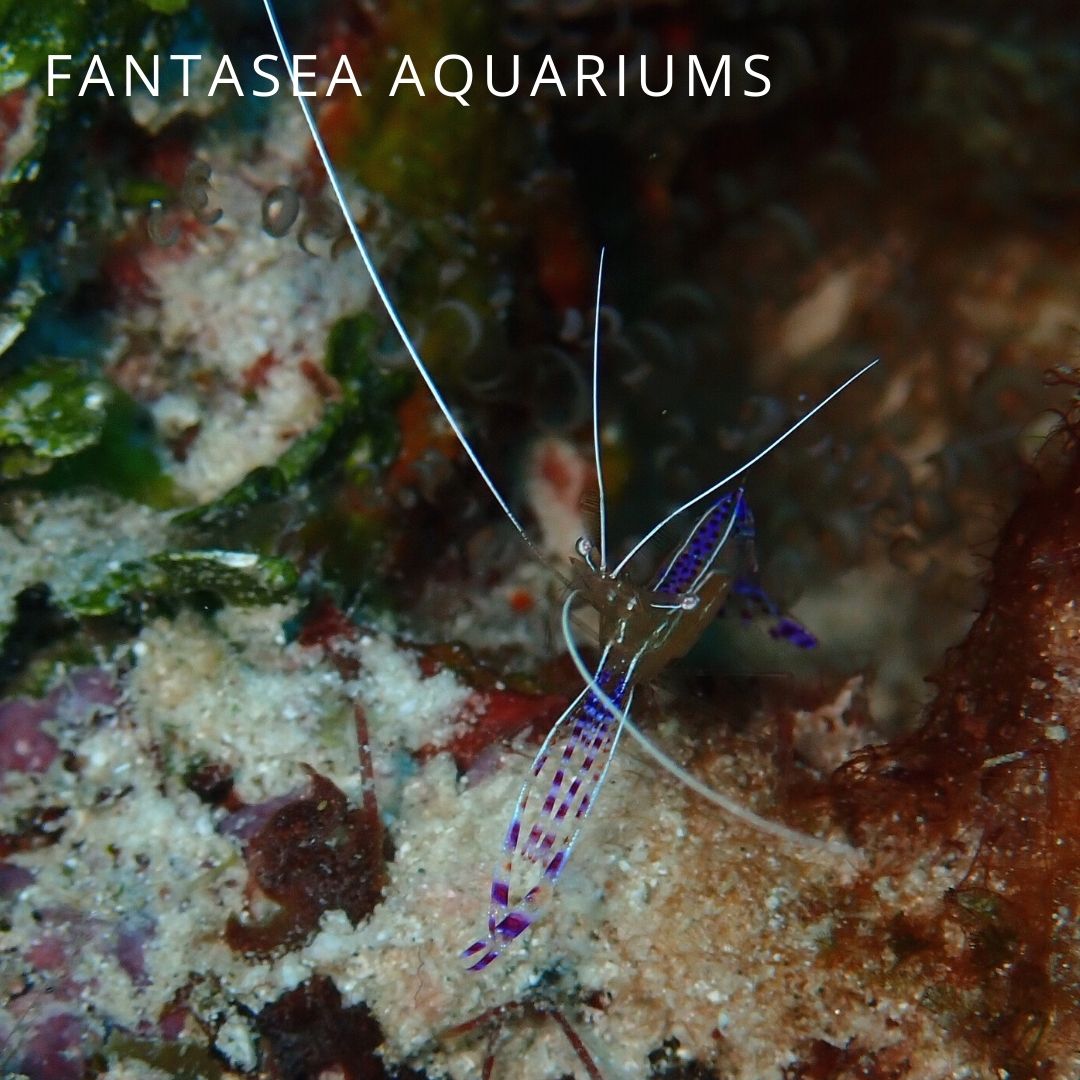

Did you know that some reef critters that aren’t closely related at all are nonetheless inseparable? This relationship between two organisms is called a symbiosis, and it’s a common survival tactic in the unforgiving underwater world.
We’ve all heard of clownfish and anemones, or watchman gobies and pistol shrimp. Below, let’s take a look at a few of our other favorite symbioses for your (reef) aquarium. Are you going fish or invert? These are the reef’s unlikely BBFs.
Squat Anemone Shrimp (Thor) + Anemone

This tiny but fierce number is better known in the hobby as the sexy shrimp. It’s widely appreciated for its pretty pattern, suitability for small tanks, and, above all, its funny dancing (some will say “twerking”) movements. We love using shrimp of the genus Thor, especially the popular Thor amboinensis, in our nano builds!
Wild squat anemone shrimp are closely associated with various anemones. Luckily for those of us who think even the easier bubble tip anemone is too much of a hassle, though, they’ll also happily live in a range of corals. Their relationship with their hosts can be described as facultative commensalism: the shrimp receive a safe home, while the anemone or coral gets nothing at all.
Wild squat anemone shrimp often occur alongside another anemone symbiont, cleaner anemone shrimp of the genera Ancylomenes and Periclimenes. As their name suggests, these make a living cleaning much larger fish. Thor dicaprio, for example — named after that DiCaprio, yes — is a frequent sight on anemones that also contain Pederson’s cleaner shrimp.
We’ve found you can keep these shrimp together in your aquarium just fine too. Just make sure there are enough hosts to go around, or you might catch them squabbling! Both feed on detritus supplemented with anemone mucus and tentacle bits in captivity, but will also benefit from regular supplemental meals.
Coral Gobies (Gobiodon) + Acropora

Are coral gobies of the genus Gobiodon the cutest fish on the reef? We’re not sure — the competition is pretty fierce — but we love their stumpy faces, suitability for small tanks, and obsession with branching corals. The smallest coral goby was described in April 2026, with the type specimen measuring a measly 21.4 centimeters. For reference, that’s about the size of a chunky bumblebee!
As their name suggests, coral gobies maintain mutualistic relationships with Acropora corals. The fish get a home and protection out of the deal, but the coral is better off, too: the gobies’ presence reduces corallivory by coral munchers like butterflyfish. Presumably this is because their skin mucous is toxic and, despite their tiny size, they do also vigorously defend their “house”.
The most popular coral goby for the aquarium is G. okinawae, better known as the yellow clown goby. The genus has a couple dozen members, though, and a good few pop up in the hobby! Ironically, most sources recommend against keeping your coral goby with its natural host, Acropora, as it can irritate smaller colonies. We don’t think bigger Acro colonies notice much of a difference, but anyway: this isn’t an obligate symbiont, so it’ll also hang out on other corals without complaint.
Did you know? Gobiodon isn’t the only coral-associated goby genus. There’s also the teeny tiny Bryaninops, the whip coral gobies, whose members associate with Acropora or whip corals (Cirrhipathes). These are unfortunately rarely available in the hobby, probably because both they’re much more difficult to keep alive.
Christmas Tree Worms (Spirobranchus giganteus) + SPS Corals

If you’re an experienced reef keeper and have mastered SPS corals, you can consider trying your hand at the most festive critter on the reef: the Christmas tree worm, a type of polychaete whose only visible part is its colorful, Christmas tree-shaped filter mouth. The bushy filter comes in a range of different colours, with some specimens sporting multiple hues at once. We spotted the pink-and-white specimen above in Thailand!
Christmas tree worms live on large, reef-building SPS corals like Porites, Cyphastrea, and Favia. Although they bore right into the coral colony to build their protective tubes, the relationship can still be considered mutualistic. Research suggests the worms enhance structural integrity, plus their swaying mouthparts appear to help create healthy water movement.
These critters aren’t necessarily common in the aquarium hobby, but you might be able to ask your LFS to order some in for you. The coral is inevitably included: you’ll usually buy a rock covered in Porites, with the Porites in turn covered in colorful worms. No worries if you don’t see them at first, because they’re able to shoot into their tubes in mere milliseconds when disturbed!
Striking a balance between feeding the worms with a variety of microfoods and avoiding fouling the water to a degree that bothers the SPS is challenging. The result is sure to stop anyone walking past your tank dead in their tracks, though, and that’s priceless.
Skunk Cleaner Shrimp (Lysmata amboinensis) + Reef Fish

Although we’re happy to maintain moray eel tanks for our clients, we do keep our hands well clear of these predatory pets’ dual pairs of jaws, thank you very much. Feeding tongs were invented for a reason! Cleaner shrimp like Lysmata amboinensis have clearly never heard of them, though: they will gladly stick their entire bodies into a moray’s maw.
The difference between our precious fingers and a skunk cleaner shrimp is that those needle-sharp teeth won’t chomp down on the former. Moray eels, groupers, and a variety of less-scary reef fish like angels know these red-and-white invertebrates perform valuable cleaning duties and are more than happy to give them a free pass to crawl all over their bodies.
The relationship between skunk cleaner shrimp and their clients is an excellent example of facultative mutualism: both species do fine on their own, but are better off meeting regularly. The fish are cleared of annoying parasites, dead skin bits, loose, scales, and other itchy discomforts, while the shrimp get a free meal and avoid having to scrounge for detritus.
Large predators are a little risky in an aquarium setting, but you can consider adding a skunk cleaner shrimp or two if you keep a peaceful community with species like yellow tangs. Add a ledge or elevated rock for the shrimp to use as a cleaning station and you might just get to see this classic symbiosis in action!
Urchin Clingfish (Diademichthys lineatus) + Long-Spined Sea Urchins

One urchin dweller you’ll occasionally come across in aquarium stores is the urchin clingfish, Diademichthys lineatus. Its name is a reference to Diadema urchins, its preferred host. This is an oddball if there ever was one: a small, elongated wiggly thing sporting a lateral stripe that blends right in with its host. It also produces toxic mucus.
Despite being finely tuned to their hosts, adult urchin clingfish are facultative symbionts that can also survive on their own. We photographed the one above in Thailand, for example, well away from the nearest sea urchin. Still, it’s a lot more interesting to keep the two together than to essentially leave your clingfish homeless!
A long-spined sea urchin (D. setosum) is easy enough to keep and feed as long as your system can accommodate its clumsy movement. As an added bonus, these urchins are widely appreciated for their excellent algae-eating skills.
You can keep Diadema urchins in most general community tanks. Everyone knows to stay away from those toxic spines! Their clingfish symbionts need more careful tankmate selection, however. Despite their wiggliness, they’re slow feeders and easily outcompeted. We recommend a mellow setting to make sure yours is comfortable and gets enough to eat.
Orangutan crab (Achaeus japonicus) + Bubble Coral

We know it’s a little hard to believe, but trust us on this one: that hairy glob in the photo really is a crustacean. The orangutan crab lends its common name from its orange fur, though with a carapace of less than an inch in diameter it’s a lot more manageable than its terrestrial namesake.
Orangutan crabs aren’t really imported for the aquarium hobby, but are sometimes offered for sale after hitchhiking in on their favorite coral, Plerogyra sinuosa. Better known as the bubble coral, this large polyp stony (LPS) coral is one of the easier species you’ll find in your local aquarium store. As long as your tank is stable, you should be able to grow it — and offer its hairy symbiont a home in its bubbles.
Your best bet for healthy bubble coral and orangutan crab coexistence is to keep the crab on a healthy, mature colony, as smaller ones may be irritated by its constant scuttling. You can target-feed the crab small meaty bits; it will also partake in whatever you feed your coral.
Conclusion
Although classic reef symbioses like that between clownfish and their anemones are fascinating to watch and easy to maintain, they’re not the only interspecies collaboration you can observe in a home tank. Many species, from dancing anemone shrimp to wacky clingfish and their urchin hosts, are better together than alone.
Fallen in love with one of these unlikely pairs, but not sure you’ve got the time or expertise to set up and maintain a saltwater aquarium? That’s where we come in! Just contact FantaSEA Aquariums: we’ll design, build, and even maintain your tank for you, so all you have to do is enjoy it.
Sources & further reading
Dirnwoeber, M., & Herler, J. (2013). Toxic coral gobies reduce the feeding rate of a corallivorous butterflyfish on Acropora corals. Coral reefs, 32(1), 91-100.
Guo, C. C., Hwang, J. S., & Fautin, D. G. (1996). Host selection by shrimps symbiotic with sea anemones: a field survey and experimental laboratory analysis. Journal of Experimental Marine Biology and Ecology, 202(2), 165-176.
Petrocelly, G. (2022). The Christmas Tree Worm (Spirobranchus giganteus) as a potential bioindicator of coral reef health. Berkeley Scientific Journal, 27(1).
Rowley, S. J. (2008). Morphological diversity and abundance in the tube-dwelling polychaete Spirobranchus giganteus (Pallas, 1766) in the Indo-Pacific: adaptations to its coral host?. University of Plymouth, England.
Titus, B. M., Froehlich, C. Y., Vondriska, C., Baker, R., & Caves, E. M. (2025). Stable isotopes disentangle niche partitioning and co‐occurrence in a multi‐species marine mutualism. Oikos, 2025(2), e10553.
Wibowo, K., Harefa, T., Mokodongan, D. F., Priyadi, A., & Peristiwady, T. (2026). Gobiodon limmoni, a new coral-associated goby (Teleostei: Gobiidae) from the Moluccas, eastern Indonesia. RAFFLES BULLETIN OF ZOOLOGY, 74, 155-164.